





























A painting of Stephen F. Austin (courtesy Texas State Library and Archives Commission).
I am remiss for having ignored The Penman for the entirety of spring. Partly my absence had to do with—well, spring! But partly it had to do with my decision to juggle two type-design projects at once for the first time. Turns out, there’s a lot to keep track of.
Lucky for us both, one of those projects is perfect for a discussion here.
Designing Austin Pen has proved enjoyable, puzzling, challenging, satisfying. It’ll be my fourteenth historical penmanship font—and the fifth member of what I consider my Texas Heroes Collection. It’s modeled after the handwriting of famous empresario Stephen Fuller Austin (1793–1836), the “Father of Texas,” from whom the Lone Star State’s capital got its name.
Stephen F. Austin did not live long, so he didn’t leave reams of handwritten material. But he did keep a diary while imprisoned in Mexico for virtually all of 1834. Austin Pen is my interpretation of Austin’s secret scribblings in this miniature journal (now in the collection of the wonderful Dolph Briscoe Center for American History).

Cover of the Austin Prison Diary.
Unlike the source materials for the other fonts in this collection—Lamar Pen (based on the hand of Mirabeau B. Lamar), Emily Austin (modeled after the hand of Austin’s sister, Emily Austin Perry), Houston Pen (inspired by the letters of Sam Houston), and Texas Hero (which replicates the script of Thomas Jefferson Rusk)—the diary Austin smuggled into his prison cell is hardly cut-and-dried. For one thing, it had very small pages, which couldn’t have been easy to fill. For another, he had to keep the little book hidden, so he ended up writing much of it in a pencil he also managed to hide.
But perhaps most interestingly, nearly 30 years later, Austin’s nephew Moses Austin Bryan (Emily’s son by her first husband) traced over most of the fading pencil lines in ink. Bryan made this entry on a blank page in his own fine hand:
Note by Moses Austin Bryan in his uncle’s diary.
I, Moses Austin Bryan on this day the twenty fifth day of December Eighteen hundred and seventy one have finished tracing the pencil marks or writing of Genl. Stephen F Austin which were made by him in this book whilst he was a prisoner in the cell No 15 of the Ex. Inquisition in the City of Mexico from the 18th day of February the day he was put in the cell No 15 till he was taken out at the end of three moths [sic] by order of the President.

Given all this confusion, I thought at first I might go for a hybrid script between Bryan’s and his Uncle Austin’s. But I soon saw that Austin’s pencil scribblings were large and strange (no doubt because of the difficulty in using an early 1800s pencil on tiny pages), and Bryan’s ink tracings were similarly peculiar—nothing at all like his fine script in the note above. I decided to focus on the original author’s hand.
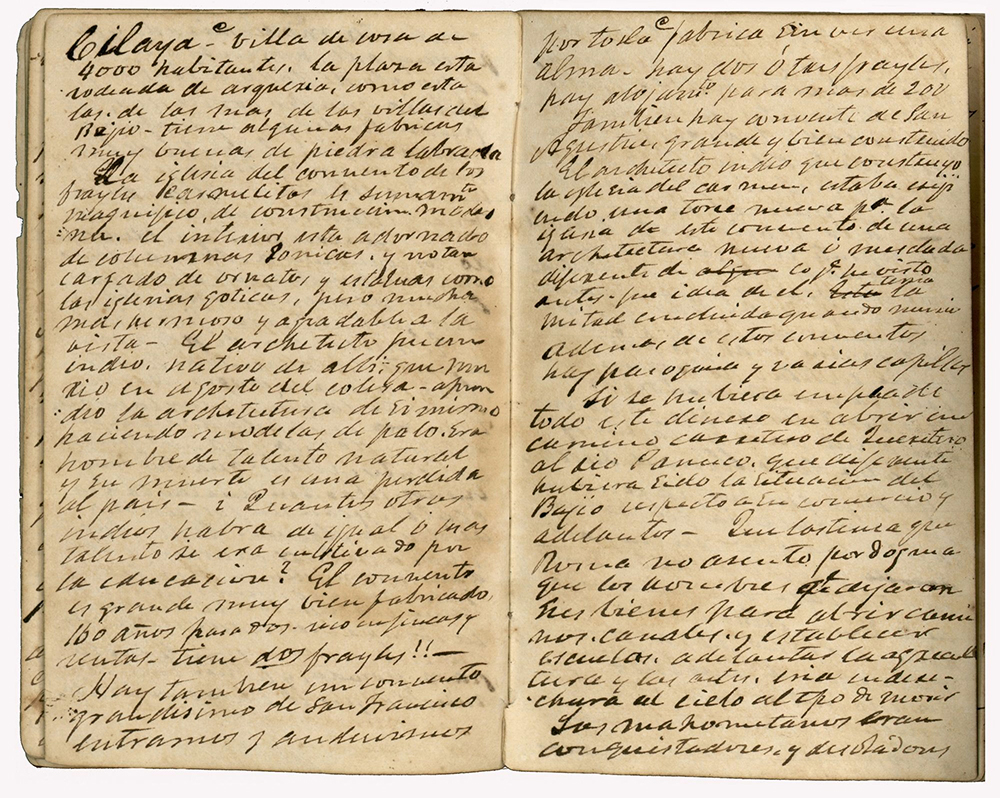
Pages showing Austin’s penmanship in ink.
And I’m happy to report that, on either side of its pencil entries, Austin filled out many of the diary’s pages in ink. And his penmanship on those pages, while fairly unkempt (understandably, considering the size of the book), had a strength and surety I admired. Those are the pages I used.
One last challenge sprung from the fact that Austin kept most of his diary in Spanish. Whereas this was fortunate in that it gave me samples of letterforms often missing in English (like Q and x), others (like K and w) are absent entirely from the Spanish alphabet. Further—not being fluent in Spanish—I occasionally had to puzzle over certain words and phrases to make sure exactly what characters I was looking at.
By now I’ve finished the entire lowercase alphabet, though, and I’m happy with the result. And from my desk in distant Maine, far from Mexico, I hope to finish Austin Pen by early August, when it’s time for the blueberry harvest.
We are in great haste to construct a magnetic telegraph from Maine to Texas; but Maine and Texas, it may be, have nothing important to communicate. —Henry David Thoreau
Note: Check this website occasionally for news on the second of the two fonts I’m working on.

Miscellanea
» Will thank-you notes—even signatures—soon be a thing of the past?
» Schools in Wisconsin, Illinois, and Florida want to keep on teaching penmanship.
» I really like this editorial call to keep putting pen to paper.
» Well, here’s a problem with poor penmanship I hadn’t thought of.
» And a special shout-out to the Campaign for Cursive—yes, cursive is cool!

A showing of Geographica Script.
Are cries of “long live longhand!” being heard? Although I don’t dare declare it so—it’s starting to seem that reports of cursive’s demise are premature.
I am remiss, meanwhile, for not having at least dashed off a little update here on The Penman over the past few months. Instead, I had my head down, working to finish our latest font, Geographica Script, a replication of 18th century roundhand. The task of type design is, for me, a matter of sustained fixation—so many tiny tasks to complete over the course of hours, days, weeks, and (in this case) months. When it comes to font work, I just dive in and go.
Perhaps it’s because elsewhere in my life I tend to procrastinate.

Professor, our modern cursive simulation.
But the font is done, and delivered to distributors, and now’s a good time to sit back and ruminate over my odd mission to preserve and make accessible old penmanship styles. It’s a mission I question often. (Is my work in fact having the opposite effect?) But when an early licensee of Geographica Script mentioned his reason for ordering—he’s up in his 70s, has missed the days of longhand, and wants to ensure that his grandchildren can read and appreciate a cursive hand—I remembered one reason I’ve been keeping the discussion alive.
That’s when I ventured a quick scan of recent online mentions of penmanship and handwriting. Lo, there’s been a shift—and the news is encouraging.
For one thing, schools in a few U.S. states have begun requiring handwriting instruction again, instruction not required by the Common Core Standards adopted in 2010. A state rep in Ohio has recently introduced a bill to require students to be proficient in cursive by fifth grade. Arizona has similar legislation on the books already. Louisiana has also begun learn cursive from third through twelfth grade. Education officials in New York City, meantime, are distributing handbooks on handwriting instruction to schools—which have the final say on whether to teach it.

Google image search for “old letters.”
And support for a revival isn’t just coming from older folks lamenting how things used to be. A younger, online crowd is showing an interest in the “ancient” art of hand-lettering. Just google “old letters,” and you’ll get more than 300 million results, and scores of lovely images of vintage script. Ironically, it seems, easy new imaging technology is managing to preserve—perhaps even popularize—that old outdated longhand.
Current typographic trends also show a fascination with loopy cursives. Just check a graphic design site or two, and you’ll see what I mean. Never mind the science that describes cognitive benefits from manipulating pens and pencils—and their tendency to slow you down.
Of course, it’s never wise to underestimate the lament of a grandparent. Nor is it a bad idea to make sure new generations can still read their ancestors’ letters—or even becoming adept at writing that way.

Examples of Library Hand.
Cataloguers’ Hand
One interesting historical handwriting relic I stumbled over the other day is Library Hand, a style of lettering developed in the late 19th century expressly for card catalogs. At a four-day gathering in 1887, librarians and “cataloguers” sought to standardize what at the time were wildly varying writing styles—not all of them legible.
(“The handwriting of the old-fashioned writing master is quite as illegible as that of the most illiterate boor,” this article in Atlas Obscura quotes from a New York Library School handbook.)
Both near-typewritten and “joined-hand” styles emerged from the 1887 meeting, each painstakingly, nitpickingly standardized. Eventually, of course, typewritten cards took hold—and more recently card catalogs have more or less completely vanished. Lucky for us, reproductions of Library Hand were saved.
Miscellanea
» Praise of the good ol’ handwritten letter (a powerful gesture).
» Another feature of handwriting (as I’ve mentioned here): it can help diagnose illness.
» Of course it can also shed light on the personality of, let’s say, the POTUS.
» Robots are even trying their mechanical hand at, well, handwriting (good luck with that).
» With longhand making something of a comeback, how will you do in this cursive quiz?
We’re not just losing handwriting: written communication generally is going away.

Detail from the journal of Mirabeau B. Lamar (1835).
I’ve mentioned here the little surge of emotion that comes when you recognize the writing of a loved one—or even, I suppose, the notes of a strict professor, or the scrawl of a stalker. In all cases, a lot more gets communicated by the slope of the letters, the look of the lines, than by the actual words and sentences themselves.
But imagine a world where those words and sentences themselves have gone missing. Imagine a virtual life in which everyone simply talks to each other, and any subtle hints to deeper meaning must come from the oldest nonverbal cues—tone of voice and facial expression. It’s where we seem to be headed in this digital age.

Detail of 1407 Bible by Gerard Brils of Belgium.
Thanks to smart devices, now within arm’s reach of most First World residents, the ease of capturing audio and video has increased a hundredfold. Podcasts are how we document change or predict the future, replacing magazine articles and newspaper columns. We listen to storytelling and standup comedy instead of going to the library to check out books to read. We’ve been suddenly thrust into a golden era of TV.
Never mind the loss of longhand—typing on a traditional keyboard has given way to hammering out txts and mssgs with just two thumbs. With autocorrect, who needs to learn how to spell? Heck, witness the sudden proliferation of emoji. Is it inconceivable that written literacy will, over not a very long time, diminish and fade?

Calligraphic font Zapfino (1998), by Hermann Zapf.
Maybe I’m being pessimistic—after all, my very livelihood depends on the written word—but consider the spread of this: “tl;dr.”
Short of an apocalyptic global catastrophe, I can think of no event that might reverse this slow extinction of reading and writing. Only if the grid goes down will we have to revert to lighting our own lamps, and making our own lampblack ink, sharpening our own quills, and pounding our own pulp into paper. I suppose that might be seen as a silver lining.

Excerpt from the diary of my father, Leslie Willson.
I’m drawn again to a page of my father’s diary—this one from 07 August 1945, the day after the bombing of Hiroshima, when he was a 22-year-old serviceman—written in his familiar cursive hand:
“I cannot conceive of any harnessed force so powerful. Although no mention was made of the actual damage done by this one bomb, its potential effect is tremendous. It may well shorten the war to weeks or days—and it may well have been the death rattle of this round green earth.”
Well, here we are more than 70 years later, and no planetary cataclysm has occurred. So it might be up to our human eye for art and history to preserve our lovely alphabets—the beauty of calligraphy, the magic of an ancient inscribed scroll. Current type design trends, in fact, seem full of fanciful scripts.
Nope, I cannot abandon hope. I can’t conceive of life without the written word.
Miscellanea
» Does the loss of cursive mean social devolution?
» Or have computers effectively taken the place of the pen?
» Have you ever noticed how your handwriting has changed over time? (Mine has.)
» Another argument why teaching handwriting to kids is a good thing.
» What do François Mitterrand and Steve Jobs have in common?
» More moving evidence of the timeless power of handwriting.


