|
|
 |
|
|
|
|
 |
 |
 |
 |
 |
 |
 |
|
|
|
|
 |
 |
 |
 |
 |
 |
 |
|
 |
 |
 |
 |
 |
 |
 |
|
|
|
 |
 |
 |
 |
|
|
|
|
The text face used here (as well as elsewhere) is Broadsheet™. The home page letters are set in Emily Austin™ & Lamar Pen™. All typefaces referenced on this website— Abigail Adams™, American Scribe™, Antiquarian™, Antiquarian Scribe™, Attic Antique™, Austin Pen™, Bonhomme Richard™, Bonsai™, Botanical Scribe™, Broadsheet™, Castine™, Douglass Pen™, Emily Austin™, Geographica™, Geographica Hand™, Geographica Script™, Houston Pen™, Lamar Pen™, Military Scribe™, Old Man Eloquent™, Remsen Script™, Schooner Script™, Terra Ignota™ & Texas Hero™ (as well as all other fonts in the Handwritten History™ Bundle)—are the intellectual property of Three Islands Press (copyright ©1994–2015). For site licensing contact: Three Islands Press P.O. Box 1092 Rockport ME 04856 USA (207) 596-6768 info@oldfonts.com |
|
|
|
|
 |
|
|
|
|
 |
|
|
Posts Tagged ‘handwritten letters’
Monday, December 21st, 2015

Recently I stumbled upon Snail Mail My Email, the website for artist Ivan Cash’s online community art project whereby hundreds of volunteers transcribe the email messages of strangers into handwritten letters, which then get dropped in the mail. A novel, fun-sounding idea, to be sure—especially once you realize that most of the letters get the sort of eye-catching embellishments you might find on a greeting card. But what struck me first was its slugline: “Handwritten Letters in a Digital World.”
The idea left me, confusingly, both encouraged and aghast.
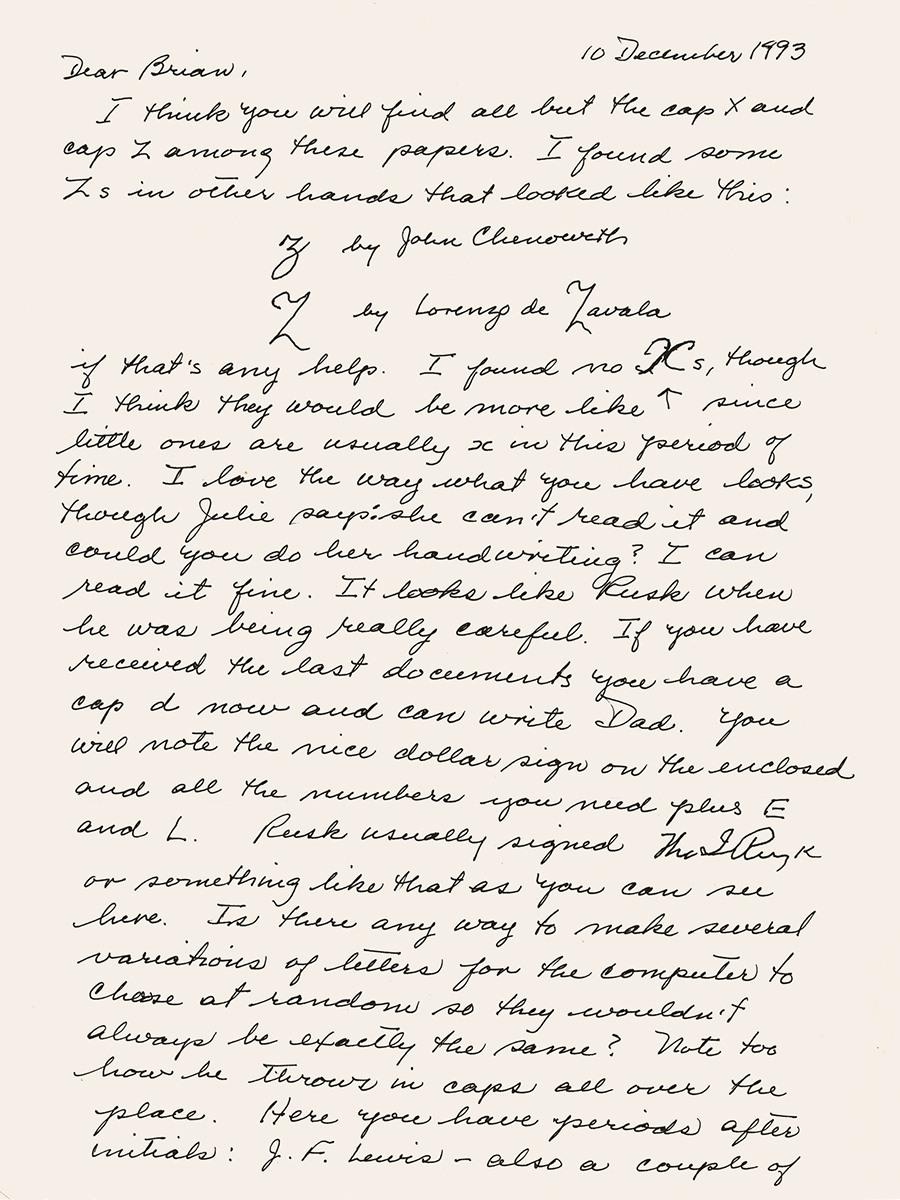 My mother helped with Texas Hero. Granted, there’s no little irony in the fact that I’m batting out these very words on the keyboard of a MacBook Pro—let alone the fact that I rarely ever send a handwritten letter these days. But if you’re a sighted person of a certain age, you’re sure to hold fast in your memory a small library of familiar handwriting samples.
Off the top of my head I can think of at least a dozen people whose penmanship I’d recognize in an instant: my parents, my siblings, my daughter, a grandfather and an aunt, two ex-wives, a couple old coworkers, a few good friends. And that’s not even counting more than a dozen others whose handwriting I’ve preserved in digital form—e.g., Abigail, Viktorie, and Marydale.
But what do you get when you open a letter in a stranger’s handwriting? There’s no flash of recognition at first glance at the hand-addressed envelope. No flutter in your gut as a face comes to mind. No proof that someone known and loved has reached out to you.
 Envelope from my father as a young man. It’s an art project, I get it. But the encounter reminded me that no more will I see envelopes freshly addressed by certain familiar pens—that of my dear mother, for instance, not even in her jiggly, Parkinson’s-induced scrawl. I can at least still revisit scores of her letters I’ve got in safe keeping. Although the flash of recognition lacks fresh brightness, it’s the work of her hand.
The power of familiar script is described with particular poignancy by Virginia resident Elsa Ann Heller, who was surprised to recognize her grandmother’s handwriting on a seventy-year-old postcard decorating a local restaurant:
“I know that sounds pretty old-fashioned, but that is how I know her. Her handwriting is written on my heart.”
 Ornament from Geographica, coming soon. Then again I’m not the only one who’s neglected his penmanship lately. Some time after Heather du Plessis-Allan, a presenter with a New Zealand current affairs TV show, broke a story exposing a loophole that let her buy a gun online without a permit, police showed up with a search warrant looking for handwriting samples. In the wake of the search—which suggests whoever ordered the gun might face punishment for breaking the law—she realized she barely handwrites anything anymore.
“Nowadays, everything is done on my laptop, tablet or cellphone. Even the grocery list. I email that to myself on the way to the supermarket.”
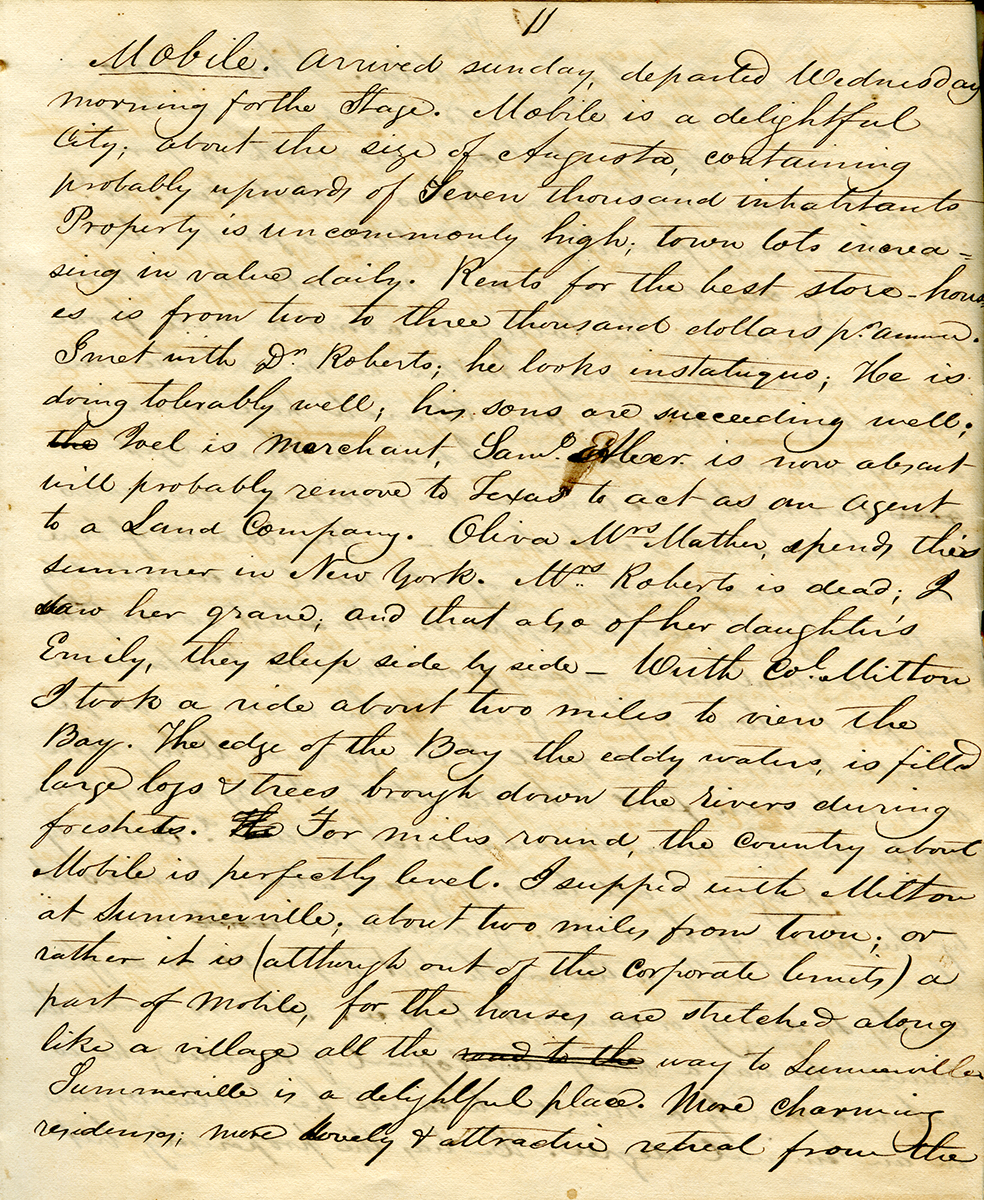
 Detail of S. F. Austin’s journal. Me, meantime? Well, I’m currently working on my first modern serif typeface ever—although it’s based on historical materials. In particular, I’m consulting the maps published by eighteenth-century English engraver Thomas Jefferys, known at the time as the “Geographer for King George III.” The neat lettering on Jefferys’s maps inspired me to give real type design a go for once.
But never fear, because after I finish Geographica, I’ll be making another old penmanship font modeled after the hand of Texas pioneer Stephen F. Austin (in his journal from a Mexican prison, circa 1834–35). And after that I’ve got a pretty cool modern handwriting font planned. Stay tuned!
Miscellanea
» It seems letter-writing clubs are a thing, and the Wonder Fair Letter Writing Club looks like a good one.
» A frightening prospect: machines have been passing the Turing Test—of handwriting.
» An art exhibit called “Good Penmanship” bids penmanship adieu.
Tags: Abigail Adams, art of handwriting, cartographic font, cursive writing, familiar handwriting, family, Geographica font, handwritten letters, letter writing clubs, Marydale font, nostalgia, old maps, penmanship, snailmail, Stephen F Austin, Thomas Jefferys, Viktorie font
Posted in Cursive, News, Old Letters, Penmanship, Ruminations, Specimens | No Comments »
Friday, September 18th, 2015
 “No Fuss, No Muss” (1901 ad). Humanity seems hellbent on following the path of least resistance. Quick and easy is what we’re after: fast food, convenience stores. Our technological trajectory aims for comfort, cleanliness, speed.
This is nothing new—the words “no muss, no fuss” (or vice versa) go back at least to an ad in the May 1901 issue of The Conservative, published in historic Nebraska City, Nebraska. We’re a species in a hurry, most obsessed with “saving time.”
Time cannot, of course, be saved. But in an age when you can buy shoes without leaving your armchair and have them delivered to your feet within the hour, why bother with the hassle of writing, say, a birthday card by hand? Why not just send email? Or, better yet, tap out a quick text message with your oh-so-nimble thumbs? “HB 2 U!”
So a sense of irony struck me the other day when I happened upon this excellent article in The Atlantic about the bane that is the ballpoint pen.
I remember back in grade school—i.e., sometime in the ’60s, when we still learned cursive writing—having a Sheaffer cartridge pen, a sort of fountain pen with a built-in, changeable ink supply. (No more messy refills!) But cheap, disposable ballpoint pens soon replaced that Sheaffer. My entire experience writing with a nib couldn’t have lasted but a couple of years.
What I didn’t recall until Josh Giesbrecht pointed it out in his piece in The Atlantic is how much easier it was to wield that old Sheaffer pen. Thin ink flows fast from a pen with a nib (speed, ease, efficiency), requiring barely a flick of the wrist to apply. A ballpoint forces you to press down hard to keep its thick ink flowing. A ballpoint takes a load of effort. There’s a lot less hand-cramp with a fountain pen.
This led Giesbrecht—who, like me, took to hand-printing after high school—to a conclusion on why he abandoned cursive writing:
“Fountain pens want to connect letters. Ballpoint pens need to be convinced to write, need to be pushed into the paper rather than merely touch it.”
Somehow, we’ve diverged onto a path of more resistance.
I want to imagine a time when old-style fountain pens become popular again, and that handwriting won’t seem such a chore. When people will choose again to take the time, to reap the benefits to brain and dexterity, to pause mid-sentence to gaze out the window, to spend a moment in thought, to ruminate. Maybe even pay a little attention to spelling and grammar.
It won’t make up for the entirety of the loss of cursive writers—you can’t stop progress, however, ill-considered—but it might preserve a beneficial talent we humans have.
In my closet is a box of family keepsakes dating back nearly a century. It’s full to the brim with letters, cards, and notes—all kept because of what had once been recorded there by hand. Such a treasure only exists because someone had funneled a sort of magic from their brain, and through their moving fingers, and onto a scrap of paper seen by the eyes of another, to be processed by another’s brain.
What’s on that scrap of paper is different from the contents of an email message. What will our keepsake boxes be filled with a century from now?
 Postcard from my grandparents to my great-grandparents, 10/22/1943.
Miscellanea
» The Australian Broadcasting Corporation considers whether the end of handwriting is near…
» …and offers up a quiz proving how diverse and distinctive it is.
» But back-to-school days here in the U.S. reveal hope for a reversal of this trend.
» Meanwhile, ChicagoNow blogger Brett Baker gets it: handwriting is personal.
» And check it out—handwritten keepsakes seem to be a thing.
» The Saugus, Massachusetts, school district is contemplating handwritten homework assignments.
» And how lovely to think of handwriting as “an irreplaceable tactile pleasure”.
Tags: art of handwriting, ballpoint, Cedar Street font, cursive, fountain pen, handwriting, handwriting in schools, handwritten letters, Lamar Pen, least resistance, nib pen, old letters, penmanship, post cards, Sheaffer cartridge pen
Posted in Cursive, Education, History, News, Penmanship, Ruminations, Science | No Comments »
Monday, August 24th, 2015
 In progress: Bonnycastle Lately I’ve been tackling a type design project that marks something of a change of pace for me. As usual, this font is inspired by hand lettering, but it’s a more formal, titling sort of face. Bonnycastle is inspired by the legends on the maps and drawings of Sir Richard Henry Bonnycastle (1791–1847), an English officer who served in the War of 1812 and ended up settling in Canada. A military engineer, Sir Bonnycastle left behind some interesting historical materials—and even wrote a couple books (such as Canada and the Canadians).
 Love letter from Johnny Cash. So, technically, yes, the source material is handwritten, but it’s not handwriting—something these days I seem always to have on the brain.
Because lately I’ve also been thinking about the power of the pen. And I don’t mean in the traditional sense of the phrase—not written content, not literature, not “the pen is mightier than the sword”—but the kind of extra gut-punch you get when reading someone’s words as put down by their very own hands and fingers.
My go-to example of this: “Victory or Death,” a powerful enough message when printed, reaches a whole nother level when you notice that young Colonel Buck Travis, writing a fortnight before he died at the Alamo, has underscored those words three times. But less dramatic, more recent, more intimate examples will likewise move the reader.
 Note from Paul McCartney. I’m thinking in particular of a letter from Johnny Cash to his wife, June Carter Cash, that appears in House of Cash (by son John Carter Cash) and has been circulated widely online. Who knew John Cash had such stylish hand-printing, with its consistent tilt and distinctively double-looped “I”? I notice that Cash, like me, had taken to using a two-story “a,” and that the tails on his “y” and “g” tend to curve to the right. It seems easy to match his hand with his on-stage persona, his flair. As cute as his endearing “Princess,” to me, is his little cross-out of the extraneous “y” at the end of “ever.” Typewritten or sent via email, such a love note wouldn’t carry anywhere near the soul.
Decided to hunt around and see what the handwriting of other musicians looked like, and I happened on a Christie’s auction lot, a letter by Paul McCartney to surrealist Desmond Morris, written in 1987 after McCartney’s wife Linda had purchased Morris’s painting “The Survivors.” It’s a brief letter, written on Blossom Wood Farm stationery in a dashed-off upright hand. The former Beatle’s style is a connected cursive, nothing fancy (although the double-stacked “c”s in his surname are interesting)—really, the kind of casual, modern handwriting you might see every day. What stands apart about McCartney’s note is how he closes with a couple of doodled portraits, apparently representing himself and Linda. They’re good. They attest to his creativity, suggest that it comes pretty easy for him, and hint at a personality people have seen since the ’60s—McCartney’s playful air. To doodle, of course, you need a pen or pencil.
 Emily Dickinson’s hand. Googled around a bit more and found samples of the penmanship of a couple of well-known American writers, Emily Dickinson (1830–1886) and Ernest Hemingway (1899–1961).
The handwriting of the 19th-century poet and the 20th-century author could hardly be less similar. Dickinson, a famous introvert and recluse, wrote in a large semi-scrawl that seems almost impossibly loose and airy (a fact that’s prompted a number of handwriting analyses). Her words are not only widely spaced but often separated further by small, peculiar dashes. Her “C,” “A,” and “W” are open and round, but the crosses on her “t”s are like sword slashes, angling viciously down. Although mostly unpublished in her lifetime, Dickinson’s poetry was for the period experimental and expressive and free—in keeping with her hand. But it could also seem intense, probing, and open-ended. Looking at her striking script, I can imagine why one of her correspondents, literary critic Thomas Wentworth Higginson, might’ve written, upon finally meeting Dickinson, that he’d never been “with any one who drained my nerve power so much. Without touching her, she drew from me. I am glad not to live near her.”
 Hemingway’s handwriting. Hemingway’s handwriting is peculiar in a different way: compact, loopy, legible—and composed along a precipitous slant. In this letter on Cuban stationery dated 20 February 1948, Papa’s loopiness is so profuse that you get the idea that his pen is simply making lines of tight, close circles, from his curvy “f”s to his rounded double “t”s—check out the words “getting” and “little”—to the curls of his “g”s and “y”s. And those “t”s are crossed just barely, very high on the circular stems. By contest, note Hemingway’s straight, vertical parentheses, or parenthetical dividers, separating his aside about Uncle Wolfie, the dead gray cat. What’s that about? (And did he really spell “gray” two ways?) Finally, those sloping lines! I thought perhaps they were an aberration, perhaps due to having to write on a cramped surface, but I found plenty of other examples of Hemingway’s slant. Everything travels downhill—until the very bottom of the page, where he has to sneak a few words above the edge of the paper.
 Letter from Isaac Newton. But even going back centuries you can feel an intimate connection to handwritten words that’s impossible via typeset text. Composed along a gentler (and opposite) slant than Hemingway’s is a letter by Sir Isaac Newton to Dr. William Briggs, written on 20 June 1682 and beginning, “I have perused [your] very ingenious Theory of Vision.” Despite its obvious age and the spread of the ink from the quill, the lines are so straight and the words dashed off with such seeming confidence that at once you get a mental picture of this 17th-century thinker as if he’d sat at his writing desk no more than a decade ago—not 333 years. There’s a clear personality here.
Try this out. Below is a note written by Johann Wolfgang von Goethe, written to longtime friend and correspondent Charlotte von Stein a hundred years after Newton’s letter. Even if you can’t interpret the words, isn’t this collection of strokes and curves (ending with a great “G”) more evocative of their polymath author than if you were staring at a text-only representation of the original German?
Collectors of such bits of history understand. Heck, autograph seekers abound. But how ironic it is that there’s something so intangibly powerful about reading words actually written by hand.
 Note from Johann Wolfgang von Goethe.
Miscellanea
» Finnish schools to phase out handwriting.
» Then again, calls to bring it back are growing louder.
» And then there’s handwriting’s reflection of character.
» Surely handwritten thank-you notes are powerful, like Taylor Swift’s…
» …or even this old hand-printed one from golfing phenom Jordan Spieth.
Tags: 17th century, 18th century, 19th century, 20th century, handwritten history, handwritten letters, historical letters, intimate connection, loopy handwriting, penmanship, personality, power of the pen, slanted handwriting, sloping handwriting
Posted in Historical Figures, History, Old Letters, Penmanship, Ruminations, Specimens | No Comments »
|
|
|
|
|
|
|
|
|