 |
|
 |
|
|
|
|
 |
 |
 |
 |
 |
 |
 |
|
|
|
|
 |
 |
 |
 |
 |
 |
 |
|
 |
 |
 |
 |
 |
 |
 |
|
|
|
 |
 |
 |
 |
|
|
|
|
The text face used here (as well as elsewhere) is Broadsheet™. The home page letters are set in Emily Austin™ & Lamar Pen™. All typefaces referenced on this website— Abigail Adams™, American Scribe™, Antiquarian™, Antiquarian Scribe™, Attic Antique™, Austin Pen™, Bonhomme Richard™, Bonsai™, Botanical Scribe™, Broadsheet™, Castine™, Douglass Pen™, Emily Austin™, Geographica™, Geographica Hand™, Geographica Script™, Houston Pen™, Lamar Pen™, Military Scribe™, Old Man Eloquent™, Remsen Script™, Schooner Script™, Terra Ignota™ & Texas Hero™ (as well as all other fonts in the Handwritten History™ Bundle)—are the intellectual property of Three Islands Press (copyright ©1994–2015). For site licensing contact: Three Islands Press P.O. Box 1092 Rockport ME 04856 USA (207) 596-6768 info@oldfonts.com |
|
|
|
|
 |
|
|
|
|
 |
|
|
Archive for the ‘Historical Figures’ Category
Sunday, September 17th, 2017
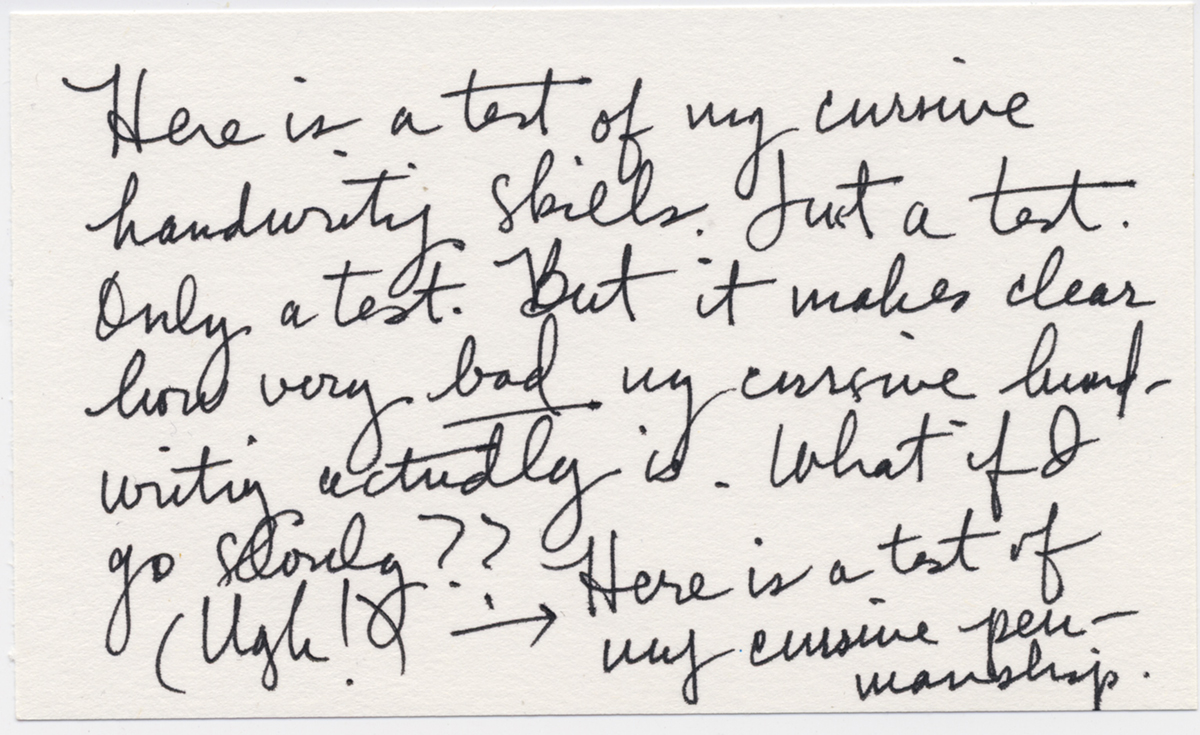 My cursive handwriting test. A confession: my cursive handwriting sucks. I write by hand so rarely these days, and when I do, it tends to come out as a sort of stylized printing I forced on myself thirty or forty years ago. So I just tried writing a few short cursive sentences on an index card to see what it looks like.
Yeah, it sucks. In fact, I couldn’t even remember how to write a capital “T.”
Alas, I’m not alone. What got me testing out my cursive today was a recent news item about how Cambridge University educators are considering dropping their handwritten exam requirement—after more than 800 years. The problem being that the faculty is having trouble reading students’ handwriting.
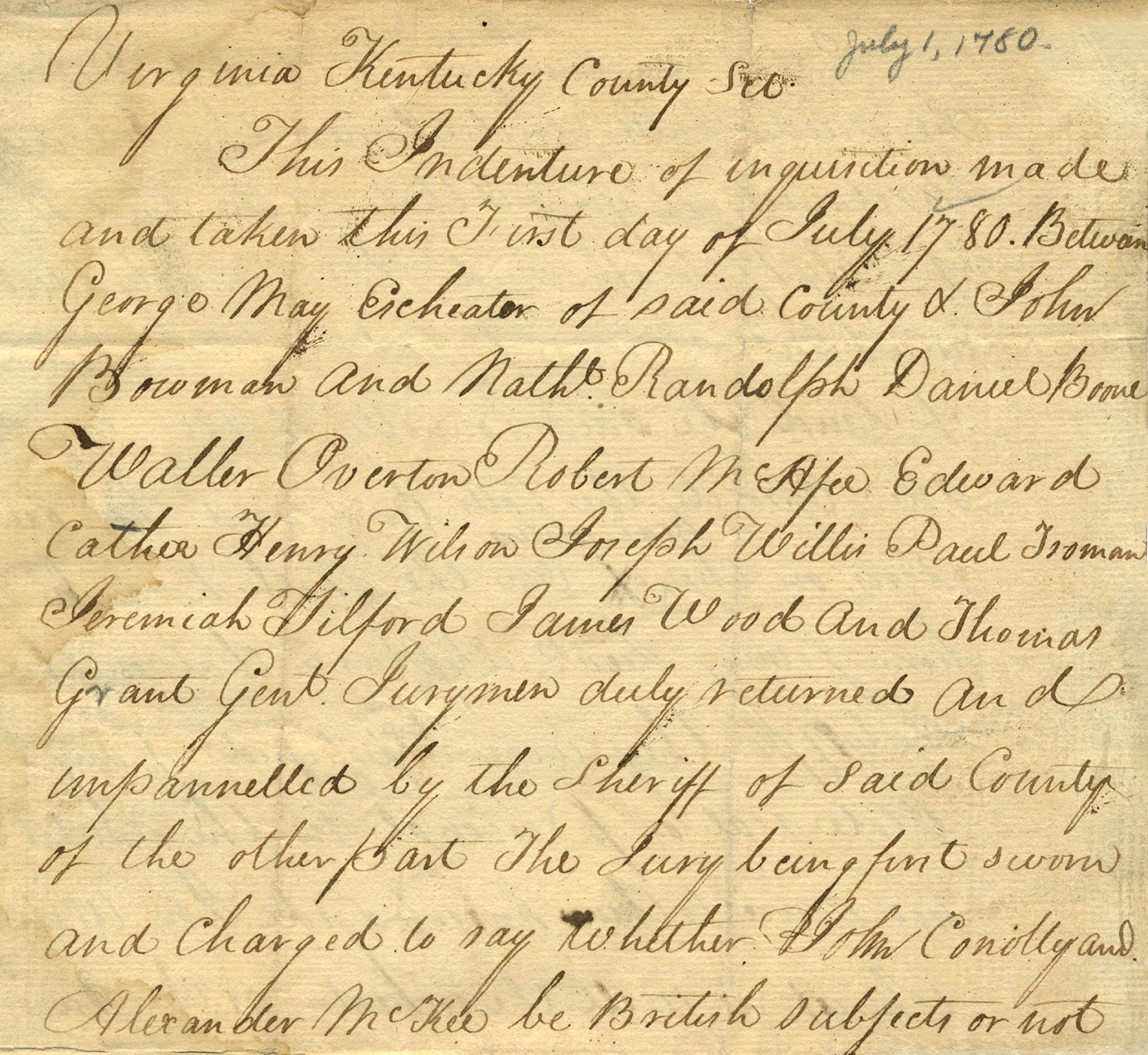 18th-century penmanship from Kentucky County, Virginia. “There has definitely been a downward trend,” says history lecturer Sarah Pearsall. “It is difficult for both the students and the examiners, as it is harder and harder to read these scripts.”
Bummer.
A Need for Speed
But I’ve long predicted this. Our smart digital devices are feeding our need for speed when it comes to all forms of communication. I mean, let’s face it: it takes a lot longer to write a thank-you note by hand than to tap out a text with your thumbs. Sure, taking the time to learn cursive might be good for your brain, your manual dexterity, and your memory, but first-world humans just prefer living in the fast lane these days, apparently.
 The handwriting of Meriwether Lewis. This got me wondering (not for the first time) how things might change if the grid goes down. Say a computer virus, an asteroid, a natural (or nuclear) disaster, solar flares, or Siri Personified takes us all offline in an instant. How will we communicate over long distances in such a post-apocalyptic scenario? Well, I reckon we’ll have to go back to scribbling out notes using charcoal on birch bark and handing them to a courier, who will deliver them to our remote recipient in person. And I can imagine the dismay on the face of our correspondent who can’t read a word we’ve written.
“Return to Sender. Illegible.”
Learn by Doing
Perhaps at the very least it’s worth practicing—if not your cursive—your hand-printing every now and then. Maybe by jotting down a grocery list, composing a thank-you note by hand, or authoring an actual letter, inserting it into an envelope, and dropping it in the U.S. Mail. I daresay pen makers and the U.S. Postal Service will appreciate it, as will your recipients. So long as they can read your writing.
The irony is that, during the decades of the decline of my penmanship, I’ve taught myself to decipher various styles of cursive handwriting from centuries gone by. And you can bet there’ll be someone with similar skills to help us out centuries from now:
“Siri, read me that old cursive letter.”
Miscellanea
» Cursive makes you smarter: a wonderful essay about all this stuff.
» Another articulate argument for not scrapping handwriting instruction.
» To heck with handwriting recognition: recognizing handwriting is a moving experience.
» Geneva, Ohio, honors the master penman who created Spencerian Script.
» Yes, truly exercising the brain sometimes takes a little time.
» On the 200th anniversary of Jane Austen’s death, a graphologist reveals a few secrets.
» Finally, Darick “DDS” Spears has released a new hip hop album called “Penmanship.”
Tags: bad penmanship, cursive, cursive hanwriting, digital devices, grid goes down, handwriting, handwriting in schools, handwritten letters, illegible, letter-writing, long-distance communication, need for speed, old handwriting, penmanship, poor penmanship, post-apocalyptic, practice, teaching cursive
Posted in 21st Century, Communication, Cursive, Education, Graphology, Historical Figures, History, Literacy, Longhand, News, Old Letters, Penmanship, Ruminations, Specimens | 2 Comments »
Tuesday, June 20th, 2017
I am remiss for having ignored The Penman for the entirety of spring. Partly my absence had to do with—well, spring! But partly it had to do with my decision to juggle two type-design projects at once for the first time. Turns out, there’s a lot to keep track of.
Lucky for us both, one of those projects is perfect for a discussion here.
Designing Austin Pen has proved enjoyable, puzzling, challenging, satisfying. It’ll be my fourteenth historical penmanship font—and the fifth member of what I consider my Texas Heroes Collection. It’s modeled after the handwriting of famous empresario Stephen Fuller Austin (1793–1836), the “Father of Texas,” from whom the Lone Star State’s capital got its name.
Stephen F. Austin did not live long, so he didn’t leave reams of handwritten material. But he did keep a diary while imprisoned in Mexico for virtually all of 1834. Austin Pen is my interpretation of Austin’s secret scribblings in this miniature journal (now in the collection of the wonderful Dolph Briscoe Center for American History).
 Cover of the Austin Prison Diary. Unlike the source materials for the other fonts in this collection—Lamar Pen (based on the hand of Mirabeau B. Lamar), Emily Austin (modeled after the hand of Austin’s sister, Emily Austin Perry), Houston Pen (inspired by the letters of Sam Houston), and Texas Hero (which replicates the script of Thomas Jefferson Rusk)—the diary Austin smuggled into his prison cell is hardly cut-and-dried. For one thing, it had very small pages, which couldn’t have been easy to fill. For another, he had to keep the little book hidden, so he ended up writing much of it in a pencil he also managed to hide.
But perhaps most interestingly, nearly 30 years later, Austin’s nephew Moses Austin Bryan (Emily’s son by her first husband) traced over most of the fading pencil lines in ink. Bryan made this entry on a blank page in his own fine hand:
 Note by Moses Austin Bryan in his uncle’s diary. I, Moses Austin Bryan on this day the twenty fifth day of December Eighteen hundred and seventy one have finished tracing the pencil marks or writing of Genl. Stephen F Austin which were made by him in this book whilst he was a prisoner in the cell No 15 of the Ex. Inquisition in the City of Mexico from the 18th day of February the day he was put in the cell No 15 till he was taken out at the end of three moths [sic] by order of the President.
Given all this confusion, I thought at first I might go for a hybrid script between Bryan’s and his Uncle Austin’s. But I soon saw that Austin’s pencil scribblings were large and strange (no doubt because of the difficulty in using an early 1800s pencil on tiny pages), and Bryan’s ink tracings were similarly peculiar—nothing at all like his fine script in the note above. I decided to focus on the original author’s hand.
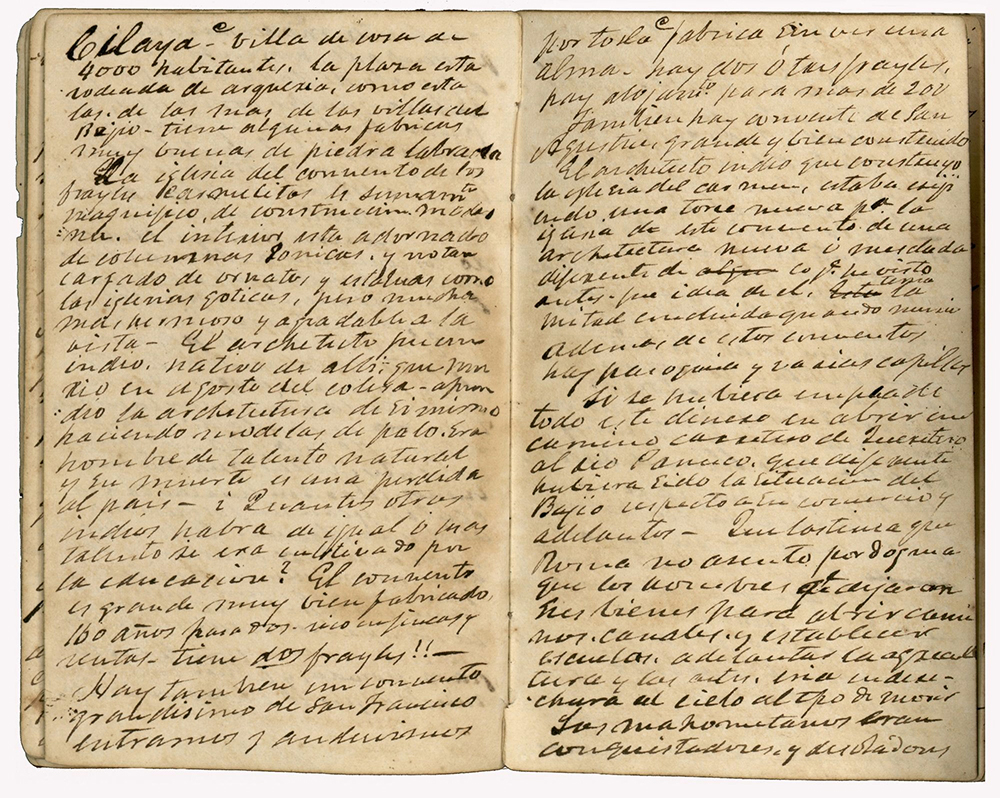 Pages showing Austin’s penmanship in ink. And I’m happy to report that, on either side of its pencil entries, Austin filled out many of the diary’s pages in ink. And his penmanship on those pages, while fairly unkempt (understandably, considering the size of the book), had a strength and surety I admired. Those are the pages I used.
One last challenge sprung from the fact that Austin kept most of his diary in Spanish. Whereas this was fortunate in that it gave me samples of letterforms often missing in English (like Q and x), others (like K and w) are absent entirely from the Spanish alphabet. Further—not being fluent in Spanish—I occasionally had to puzzle over certain words and phrases to make sure exactly what characters I was looking at.
By now I’ve finished the entire lowercase alphabet, though, and I’m happy with the result. And from my desk in distant Maine, far from Mexico, I hope to finish Austin Pen by early August, when it’s time for the blueberry harvest.
We are in great haste to construct a magnetic telegraph from Maine to Texas; but Maine and Texas, it may be, have nothing important to communicate. —Henry David Thoreau
Note: Check this website occasionally for news on the second of the two fonts I’m working on.

Miscellanea
» Will thank-you notes—even signatures—soon be a thing of the past?
» Schools in Wisconsin, Illinois, and Florida want to keep on teaching penmanship.
» I really like this editorial call to keep putting pen to paper.
» Well, here’s a problem with poor penmanship I hadn’t thought of.
» And a special shout-out to the Campaign for Cursive—yes, cursive is cool!
Tags: 1800s, 19th century, Austin Pen, cursive, diaries, Emily Austin, Emily Austin Perry, handwritten font, handwritten font. historical font, Houston Pen, journals, Lamar Pen, Mirabeau B Lamar, Moses Austin Bryan, old handwriting font, penmanship, prison diary, quill pen, Sam Houston, Stephen F Austin, Texas Hero, Thomas Jefferson Rusk, vintage font
Posted in 19th Century, Cursive, Historical Figures, History, Longhand, Old Letters, Penmanship, Specimens, Type Design | No Comments »
Thursday, September 15th, 2016
 Amerique Septentrionale (detail). It all began with my fascination with old maps. Long before I’d even designed my first font, in fact, my parents had given me a collection of printed maps of Texas from the 1500s to the 1900s called Contours of Discovery.
I marveled at the hand-lettered legends and place names and how they differed over the centuries—and years later modeled Terra Ignota after the lettering on one of these prints, Amerique Septentrionale, by French cartographer Nicolas Sanson d’Abbeville.
 Cartographic work of Emanuel Bowen (detail). To date, I’ve released five typefaces inspired by maps and charts from the 17th through 19th centuries, most recently my first-ever serif text-type family, Geographica. My plan was to offer two kindred fonts—a script and a hand—that simulate the penmanship on Geographica’s source materials, the mid-1700s maps of English engravers Emanuel Bowen and Thomas Jefferys.
And in rounding out the character set for the first of these, Geographica Script, I stumbled on a fascinating phenomenon I’d never heard of: trade cards. In particular, British and Colonial American trade cards from the 1700s that, like cartographic prints from the period, demonstrated ornate 18th century penmanship.
 Trade card for Spermacaeti Candles (click for larger view). The precursors of modern business cards, trade cards were designed, engraved, and printed for tradesmen, service providers, and salespeople to distribute to potential customers as introductions to (or advertisements for) their particular businesses. Not only were these cards covered in fancy, graceful round hand, but they usually also featured opulent floral designs and period illustrations of products and popular symbols—like anchors, crowns, doves, and lions rampant.
As soon as I laid eyes on 18th century trade cards, Geographica Script got a lot more interesting: it’ll come with many such ornaments.
 William Hogarth illustration. A number of the images I found—in collections from such places as the British Museum, the Museum of London, and Yale’s Lewis Walpole Library—were the work of English printmaker William Hogarth, an artist and cartoonist credited with pioneering western sequential art. The prolific Hogarth was a master at reproducing the iconic symbols of the period.
And the round hand itself on these varied, intricate cards added a plethora of flourishes, swashes, and embellishments. Curls and loops, fancy ampersands. (My OpenType-features cup overfloweth.) Plus, I learned a few things, such as the meaning of the ubiquitous abbreviation “NB” (nota bene, or note well) and the fact that, as long as 250 years ago, we English speakers were fond of the phrase “all sorts of.”
Geographica Script is taking longer than I’d imagined, but I’m anxious to find out how it’s received. (There’ll even be a unicorn!) I dare not predict a release date, but keep your eyes peeled.
 Geographica Script unicorn rampant. * * *
A few trade card links:
• Trade cards at the British Museum
• Trade cards at the Museum of London
• Trade cards at the Fitzwilliam Museum
• Search the Lewis Walpole Digital Images Collection
• Trade cards on Pinterest
Miscellanea
» Do this: take five minutes to listen to this TED talk by Lakshmi Pratury on letter-writing. (Just do it.)
» Here’s a transcript of the Ted Radio Hour podcast about Laskhmi Pratury’s talk (and a link to the podcast).
» Civil War amputees helped by left-handed penmanship contests…
» …and Geneva, Ohio, students participate in a Spencerian handwriting contest.
» The power of cursive penmanship in the 21st century, in response to…
» …Anne Trubek’s opinion in the New York Times (that handwriting no longer matters).
» Japan’s prime minister wins praise for his handwriting’s “good-looking characters.”
Tags: 1700s, 18th century penmanship, antique cartography, antique penmanship, British Museum, Emanuel Bowen, Geographica Script, handwritten fonts, historical maps, historical script fonts, Lewis Walpole Library, lion rampant, Museum of London, old handwriting, round hand, Thomas Jeffreys, trade cards, unicorn rampant, vintage handwriting, William Hogarth
Posted in 1700s, 18th Century, Cursive, Historical Figures, History, Penmanship, Round Hand, Specimens | No Comments »
|
|
|
|
|
|
|
|
|


